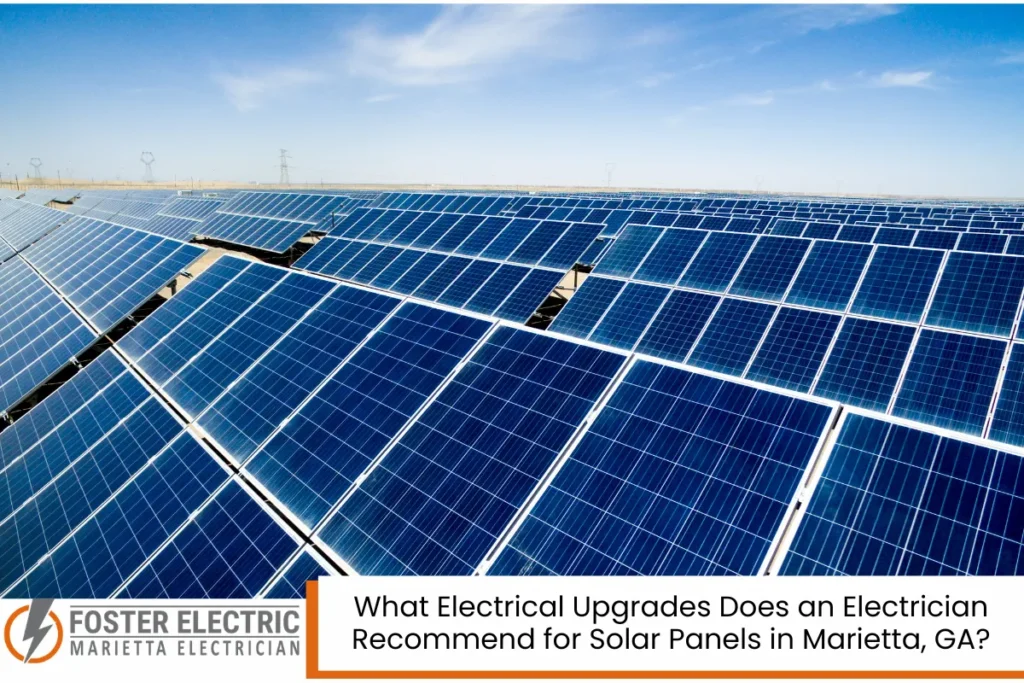
An electrician should evaluate more than roof space before solar panels are connected to a Marietta home. An undersized service, crowded panel, outdated grounding system, or poorly planned interconnection can delay approval, reduce performance, and create safety concerns. Those problems become more frustrating after equipment is purchased and installers discover that the existing electrical system cannot support the array, battery, or loads. The practical solution is a pre-solar electrical assessment that identifies necessary upgrades early. Depending on the property, recommendations may include a service-panel replacement, breakers, meter or service modifications, surge protection, grounding and bonding improvements, rapid-shutdown equipment, labeled disconnects, and battery-ready circuits. Planning these upgrades first helps the project pass inspection, coordinate with the utility, and operate for years.
Why Solar Panels Often Require More Than a Rooftop Installation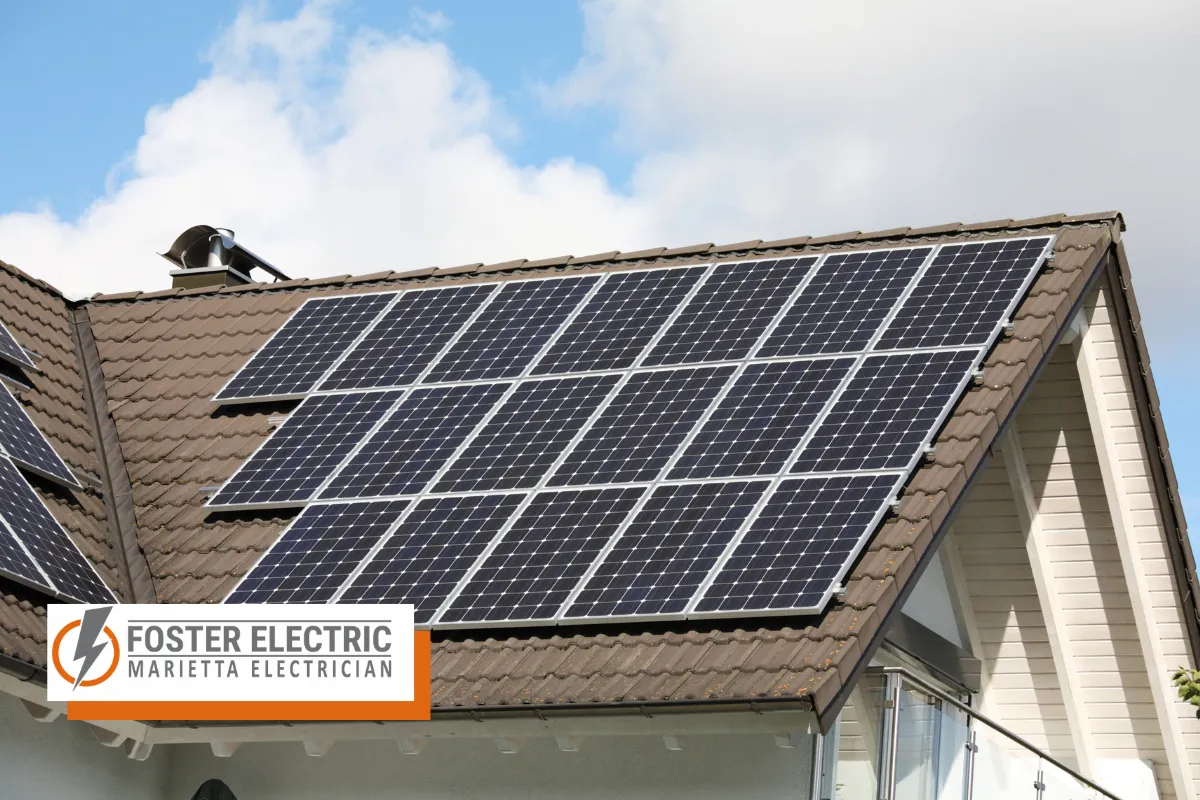
A residential solar photovoltaic system becomes part of a home’s electrical infrastructure. The panels generate direct-current electricity, the inverter converts it into alternating current, and the resulting power is connected to the home’s distribution system.
That connection must be designed around the capacity and condition of the existing equipment. A modern home with a spacious 200-amp panel may need only limited modifications. An older Marietta property with a 100-amp service, obsolete components, or a fully occupiedpan breaker el may require more substantial work.
The most common electrical upgrades recommended before solar installation include:
- Replacing or expanding the main electrical panel
- Increasing the electrical service capacity
- Installing properly sized solar breakers
- Modifying the meter base or service equipment
- Adding an exterior AC disconnect
- Improving grounding and bonding
- Installing whole-home surge protection
- Adding rapid-shutdown and emergency labeling
- Preparing circuits for battery storage
- Correcting existing code and safety defects
These upgrades are not automatically required for every property. The appropriate scope depends on the solar array size, inverter output, panel rating, service configuration, utility requirements, existing household loads, and plans for batteries, electric vehicles, heat pumps, or other equipment.
Start With a Complete Electrical Load and Service Evaluation
Before recommending upgrades, a residential electrician should determine how much electrical capacity the home currently has and how much of that capacity is already being used.
This process usually includes reviewing:
- The main service rating
- The panel bus rating
- The main breaker size
- Existing branch circuits
- Major appliances
- Heating and cooling equipment
- Electric water heating
- EV charging equipment
- Pool pumps or workshop loads
- Planned battery storage
- Available breaker spaces
- The condition of service conductors
- The proposed solar inverter output
A service labeled 200 amps does not necessarily mean every associated component is rated or configured for the same load. The meter base, service entrance conductors, main disconnect, panel bus, and grounding electrode system must be evaluated together.
An accurate load calculation is especially important when the homeowner intends to combine solar with broader electrification. A property that currently uses gas appliances may have adequate capacity for solar but require additional planning when an electric range, heat pump, water heater, or Level 2 vehicle charger is added later.
When a Main Electrical Panel Upgrade Becomes Necessary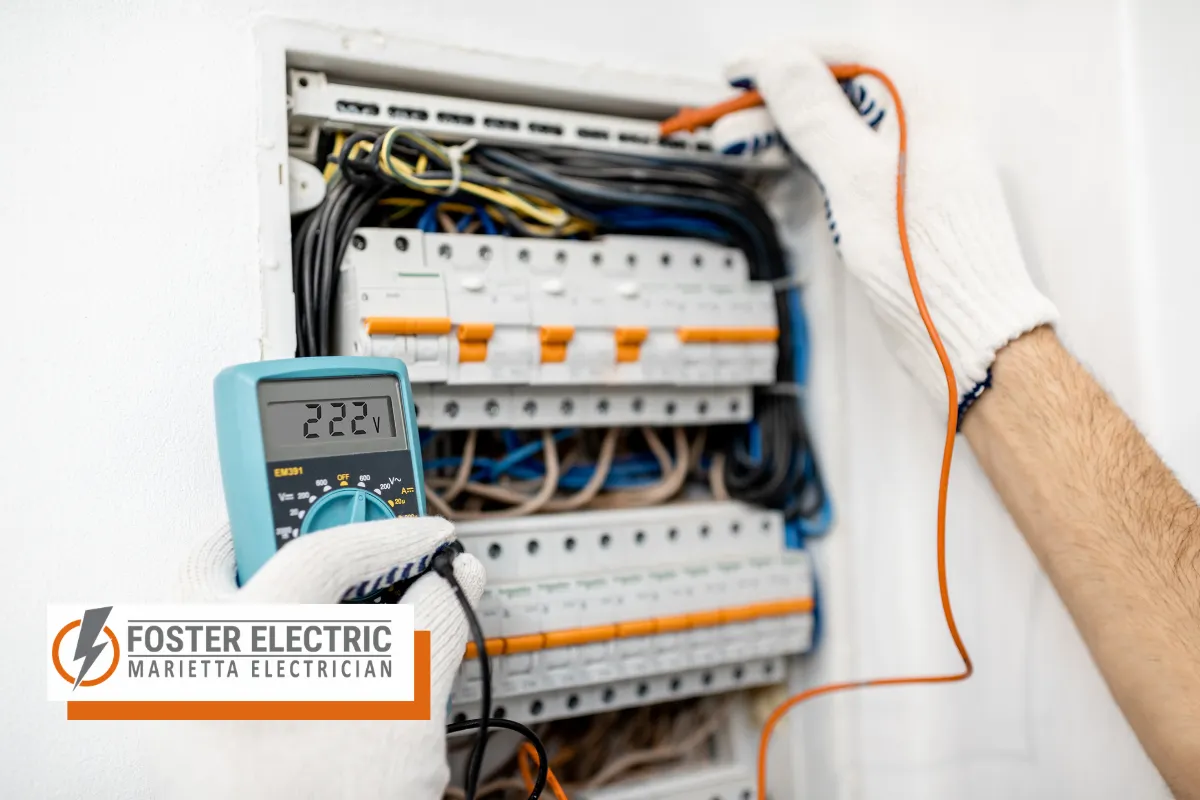
The main panel distributes electricity throughout the home and provides the point where many residential solar systems connect. Its rating, design, condition, and available space directly affect the interconnection plan.
The Existing Panel Has No Open Breaker Spaces
A solar installation commonly requires a dedicated two-pole breaker. If every position is occupied, the electrical contractor may recommend one of several solutions:
- Reorganizing eligible circuits
- Installing approved tandem breakers where permitted
- Adding a subpanel
- Replacing the main panel with a larger model
- Using an alternative interconnection method
Circuit consolidation should never be improvised. The panel labeling, manufacturer specifications, breaker compatibility, conductor sizes, and load calculations must all be reviewed.
A subpanel can create additional branch-circuit space, but it does not automatically increase the total electrical capacity of the service. It may solve a space problem without solving an amperage limitation.
The Panel Bus Rating Cannot Support the Solar Backfeed
Many solar systems use a load-side connection, meaning the inverter output is connected through a breaker in the main distribution panel. The size and placement of that breaker must comply with the applicable electrical code and the panel’s ratings.
The panel bus rating, main breaker rating, and solar breaker size are considered together. Depending on the equipment and design, a solar breaker may need to be positioned at the opposite end of the bus from the main breaker.
When the proposed inverter output exceeds what the existing panel can accept, the recommended options may include:
- Reducing the inverter output
- Replacing the panel with equipment that has a higher bus rating
- Using a supply-side connection
- Installing listed power-control equipment
- Reconfiguring the service equipment
A local electrician should verify the allowable interconnection method rather than relying on a generalized solar estimate.
The Panel Is Damaged, Corroded, or Obsolete
Solar equipment should not be connected to a deteriorated panel. Signs that may justify replacement include:
- Heat damage
- Burned bus connections
- Rust or water intrusion
- Loose breaker connections
- Cracked internal components
- Missing covers or knockouts
- Improperly doubled conductors
- Breakers that are not listed for the panel
- Evidence of repeated overheating
- Equipment for which compatible replacement parts are unavailable
Even when the panel appears operational, hidden defects can affect reliability. Solar generation introduces another power source, making sound connections and correctly rated equipment essential.
Upgrading From a 100-Amp to a 200-Amp Service
A 100-amp service is not automatically incompatible with solar. Some modest systems can be integrated safely without increasing the service size.
However, a 200-amp service upgrade may be recommended when the home has limited capacity, multiple large electrical loads, or future electrification plans. Solar generation itself does not function like an additional household load, but the overall interconnection design and planned equipment must be considered.
A service upgrade can involve more than replacing the breaker panel. The work may include:
- New service entrance conductors
- A new meter enclosure
- A new exterior disconnect
- Updated grounding electrodes
- New bonding connections
- Utility coordination
- Weatherhead or mast modifications
- Raceway replacement
- Interior panel replacement
- Repair of wall or exterior finishes
The utility may need to disconnect and reconnect power while the work is completed. Equipment locations, clearances, conductor routing, and service attachment conditions can also affect the project scope.
Homeowners should not assume a larger service is always the best or only answer. Load-management systems and power-control equipment may provide alternatives in certain designs, particularly when the goal is to add large future loads without immediately replacing the entire service.
Meter Base and Utility-Service Modifications
The meter enclosure is part of the service configuration and may require attention during a solar project.
An older meter base may be damaged, undersized, incompatible with the proposed arrangement, or unsuitable for required utility equipment. In other cases, the utility may require a meter replacement or a specific service configuration before granting permission to operate.
Potential meter-related work includes:
- Replacing a deteriorated meter socket
- Installing a solar-compatible meter enclosure
- Creating space for utility metering equipment
- Relocating obstructed equipment
- Correcting improper service bonding
- Updating service conductors
- Installing an exterior service disconnect
- Adjusting the connection point for distributed generation
The applicable utility depends on the property’s service territory. Marietta maintains a distributed-generation application process that calls for an electrical permit and a one-line diagram showing major equipment such as inverters, generators, disconnects, and related components. And municipal inspections are separate steps. Passing a city electrical inspection does not, by itself, authorize the homeowner to energize a grid-connected solar system. Permission to operate must be obtained through the applicable interconnection process.
The Dedicated Solar Breaker and Interconnection Point
The solar breaker carries the inverter’s alternating-current output into the home’s electrical distribution system. It must be correctly sized for the inverter output, conductors, panel rating, and continuous-current requirements.
The breaker must also be listed for use with the panel. A breaker that physically fits is not necessarily approved for that panel model.
During the review, electricians examine:
- Inverter maximum continuous output current
- Breaker rating
- Conductor ampacity
- Panel bus rating
- Main breaker rating
- Breaker placement
- Available spaces
- Manufacturer instructions
- Temperature and conduit-fill considerations
- Required markings
A poorly selected breaker can cause nuisance tripping, overheating, inspection failure, or damage to connected equipment.
Load-Side Connections
A load-side connection is made through a breaker in the electrical panel. This is a common residential method because it allows the solar source to connect through standard overcurrent protection.
The design is limited by the panel’s configuration and allowable backfeed capacity. It may be a good option when the service equipment is modern, correctly rated, and has sufficient space.
Supply-Side Connections
A supply-side connection is made between the utility service point and the main service disconnect. This method may be considered when the main panel cannot accept the proposed solar breaker.
Supply-side connections require careful design. They may involve service-rated disconnects, overcurrent protection, conductor taps, utility coordination, and specific equipment clearances. The work should be performed only by qualified professionals familiar with service equipment and the applicable approval process.
Grounding and Bonding Improvements for Solar Equipment
Grounding and bonding are related but distinct safety functions.
Grounding connects the electrical system to the earth through grounding electrodes. Bonding creates a low-impedance path between conductive components so that a fault can operate the appropriate protective device.
A solar project may expose weaknesses in an older home’s grounding electrode system. The electrical service assessment may identify:
- Missing or damaged grounding electrode conductors
- Improper connections to metal water piping
- Inadequate grounding electrodes
- Loose bonding jumpers
- Improper neutral-to-ground connections
- Unbonded metal enclosures
- Corroded clamps
- Inconsistent equipment-grounding paths
The solar array’s racking, inverter, disconnects, raceways, and associated metal components must be grounded or bonded according to their listing, installation instructions, and applicable code.
A residential electrician may also correct neutral and grounding separation problems in downstream panels. Neutrals and equipment-grounding conductors are generally separated after the service disconnect so objectionable current does not flow on metal enclosures and grounding paths.
Read Marietta Electrician Guide: How Do You Know If Your Panel Can Handle New HVAC Units or Appliances?
Whole-Home Surge Protection for Sensitive Solar Electronics
Solar systems contain electronic components that can be damaged by voltage surges. Inverters, optimizers, monitoring equipment, battery controls, smart appliances, and connected devices may all be vulnerable.
A whole-home surge protective device is commonly recommended at or near the service equipment. Depending on the system design, additional surge protection may be installed at solar equipment or other distribution points.
Surge protection can help reduce damage from:
- Utility switching events
- Nearby lightning activity
- Large motors cycling on and off
- Internal electrical disturbances
- Inductive loads
- Voltage transients
No surge protective device can guarantee protection from every lightning event. A direct strike can exceed the capability of ordinary residential protection. However, a properly installed device can reduce exposure to many common transient voltages.
The device must be listed, correctly rated, and installed with short conductor paths where practical. Long leads can reduce performance because added conductor length increases impedance.
Rapid-Shutdown Equipment and Emergency Disconnects
Modern rooftop solar systems require safety features that allow designated conductors near or within the array boundary to reduce voltage rapidly during an emergency.
Rapid-shutdown equipment is intended to improve conditions for firefighters, emergency responders, technicians, and others who may need to work around the building.
A compliant system may include:
- Module-level power electronics
- A listed rapid-shutdown initiation device
- Compatible inverters
- Clearly marked controls
- Required warning labels
- Proper conductor routing
The exact design depends on the system architecture and product listing. The rapid-shutdown components must be compatible with one another. Mixing equipment without confirmed compatibility can lead to failed inspections or unsafe operation.
An exterior AC disconnect may also be required by the design, utility, or authority having jurisdiction. It should be accessible, properly rated, and clearly identified.
Solar Labels, Placards, and One-Line Diagrams
Solar systems contain multiple power sources and must be labeled so occupants, technicians, inspectors, utility personnel, and emergency responders can understand the installation.
Required markings may identify:
- The photovoltaic power source
- The AC disconnect
- The rapid-shutdown switch
- The point of interconnection
- The location of additional power sources
- Maximum circuit voltage
- Operating current
- Service equipment supplied by more than one source
- Battery energy-storage equipment
- Conductors that remain energized
Labels must be durable and suitable for the location. Handwritten notes or ordinary paper stickers are not appropriate substitutes for required permanent markings.
A one-line diagram gives reviewers a simplified representation of the system. It generally shows the panels, combiners, inverter, disconnects, service equipment, utility meter, overcurrent protection, conductor details, and grounding arrangement.
Marietta’s distributed-generation application specifically requests a one-line diagram showing major electrical equipment. Upgrades for Home Energy Storage
Homeowners who may add battery storage later should discuss that possibility before the solar equipment is installed. A battery-ready design can reduce future rework.
Preparation may include:
- Reserving wall space near electrical equipment
- Installing conduit pathways
- Providing breaker capacity
- Selecting compatible inverters
- Planning a critical-loads panel
- Evaluating ventilation and working clearances
- Reviewing equipment-location restrictions
- Installing communications wiring
- Planning whole-home or partial-home backup
- Evaluating service-isolation equipment
A grid-connected solar array does not necessarily power the home during an outage. Standard inverters usually shut down when utility power is lost so electricity is not exported onto lines that utility crews may be repairing.
Backup operation generally requires compatible battery storage, control equipment, and an isolation method that separates the home from the utility grid.
Critical-Loads Subpanels
A critical-load panel supplies selected circuits during an outage. Typical choices include refrigeration, lighting, internet equipment, garage-door controls, selected receptacles, medical devices, and a limited heating or cooling load.
Not every circuit should automatically be placed on backup. Large loads can drain a battery quickly or exceed inverter output.
An electrical service professional can help prioritize circuits based on:
- Battery capacity
- Inverter output
- Starting current
- Expected outage duration
- Homeowner priorities
- Seasonal demand
- Available solar production
Existing Electrical Defects That Should Be Corrected First
A solar installation may trigger a closer inspection of existing electrical equipment. The purpose is not to rebuild every part of the house, but defects that affect the new work or create immediate hazards may need correction.
Common findings include:
- Open junction boxes
- Double-tapped breakers
- Improper wire splices
- Missing panel covers
- Damaged service conductors
- Loose terminations
- Incorrect breaker sizes
- Overloaded circuits
- Unsupported raceways
- Missing grounding connections
- Water intrusion
- Improperly installed subpanels
- Unlisted equipment combinations
Correcting these defects before solar interconnection can prevent delays and reduce the chance that weaknesses in the existing system will affect the new equipment.
Permit, Inspection, and Licensing Requirements in Marietta
The City of Marietta states that an electrical permit is required for work performed on electrical systems. Solar-related electrical modifications therefore should be planned around the municipal permit and inspection process. Marietta identifies the current construction codes adopted through the Georgia Department of Community Affairs. Georgia’s listed electrical standard is the 2023 National Electrical Code with Georgia amendments effective in 2026. requirements may involve several areas of the NEC, including provisions concerning:
- Solar photovoltaic systems
- Energy-storage systems
- Services
- Grounding and bonding
- Overcurrent protection
- Wiring methods
- Surge protection
- Disconnecting means
- Equipment marking
- Interconnected power-production sources
Georgia consumer guidance also explains that residential solar installation may constitute electrical contracting and that the installer must be associated with a licensed electrical contractor in Georgia. confirm licensing, permits, inspections, utility applications, and permission to operate rather than assuming the solar sales company is handling every step.
Questions to Ask Before Approving Electrical Upgrades
A clear proposal should explain why each upgrade is recommended and how it relates to the solar design.
Ask the contractor:
- What is the current service and panel rating?
- How much backfeed can the existing panel accept?
- Is a load-side or supply-side connection proposed?
- Does the panel have approved breaker space?
- Will the meter base require replacement?
- Is an exterior disconnect required?
- Are grounding or bonding corrections needed?
- Does the design include rapid shutdown?
- Is whole-home surge protection included?
- Can the system accommodate a future battery?
- Who will obtain the electrical permit?
- Who will submit the utility interconnection application?
- What must happen before permission to operate?
- Will power be interrupted during the upgrade?
- Are drywall, siding, or landscaping repairs included?
Detailed answers help homeowners compare proposals based on scope rather than price alone.
A Practical Sequence for a Smoother Solar Project
A well-organized project generally follows this sequence:
1. Review Electricity Use and Future Plans
The homeowner and contractor discuss current energy consumption, proposed solar size, battery goals, EV charging, and expected appliance changes.
2. Inspect the Existing Electrical System
The panel, service, meter equipment, grounding, bonding, major loads, and potential equipment locations are assessed.
3. Complete the Electrical Design
The design establishes the connection method, conductor sizes, breaker ratings, disconnects, rapid shutdown, labels, and equipment compatibility.
4. Submit Permit and Interconnection Documents
The required plans, one-line diagram, equipment specifications, permit application, and utility forms are submitted.
5. Perform Approved Electrical Upgrades
The contractor completes panel, service, grounding, disconnect, or surge-protection work included in the approved scope.
6. Install and Inspect the Solar Equipment
The array, inverter, wiring, and related equipment are installed and inspected.
7. Obtain Utility Authorization
The system remains off or in the required non-export condition until the utility grants permission to operate.
Following this sequence reduces the risk of purchasing equipment before the home’s electrical limitations are known.
The Right Upgrades Create a Safer Path to Solar
The most valuable solar upgrade is not necessarily the largest or most expensive one. It is the upgrade that resolves a verified limitation in the home’s electrical system.
For some Marietta properties, the existing 200-amp service and modern panel can accommodate solar with a dedicated breaker, disconnect, labels, and surge protection. Other homes may need a panel replacement, service upgrade, grounding corrections, meter work, or a different interconnection method.
The decision should be based on an on-site evaluation, load calculations, equipment specifications, utility requirements, and the currently adopted electrical code. Early planning also makes it easier to prepare for battery storage, vehicle charging, and additional electric appliances.
By involving qualified electricians before the solar equipment is finalized, homeowners can avoid redesigns, control costs, support inspection approval, and build a system that fits both present needs and future energy plans.
Electrician in Marietta, GA – Foster Electric
Foster Electric helps homeowners prepare safe, code-conscious electrical systems for solar panel installations throughout Marietta, Georgia, and prominent surrounding areas. We inspect service capacity, panel condition, grounding, bonding, disconnect locations, surge protection, and space for future batteries or EV charging. Our team explains which upgrades are necessary, which are optional, and how each recommendation supports permitting, inspection, and reliable operation. When you need an electrician who can coordinate electrical service improvements before solar equipment is connected, call Foster Electric at (404) 855-4797. We provide clear guidance, careful workmanship, and solutions tailored to your home’s infrastructure. Contact us or fill out our contact form to schedule an assessment and move your solar project forward with confidence, fewer surprises, and dependable support.
Frequently Asked Questions
Can solar panels be installed before an older roof is replaced?
They can, but installing solar over a roof that is nearing the end of its service life may create unnecessary future costs. The panels, racking, wiring, and flashing may need to be removed and reinstalled when reroofing becomes necessary. Before proceeding, homeowners should obtain a qualified roof assessment and compare the anticipated roof life with the expected solar-system life. The electrical design may also be affected if equipment must be relocated during future roofing work. Coordinating the roofing and solar schedules can protect flashing details, reduce duplicated labor, and make it easier to preserve equipment warranties and safe wiring routes.
Will adding an electric vehicle charger after solar require another panel upgrade?
Possibly. The answer depends on the service rating, calculated household load, charger amperage, panel capacity, and any load-management equipment. A solar installation does not automatically create additional capacity for a Level 2 charger. Solar production varies, while the service and panel must remain suitable when the charger operates at night or during low production. Homeowners planning to buy an electric vehicle should mention it during the initial assessment. The contractor may reserve breaker space, install conduit, select a larger panel, or recommend an energy-management system that limits charging when household demand approaches the service rating.
Should homeowners notify their insurance company before installing solar panels?
Homeowners should review the proposed installation with their insurance provider before work begins. Rooftop panels, inverters, batteries, and related equipment may affect property coverage, replacement-cost calculations, liability limits, or documentation requirements. The insurer may request permits, final inspection records, equipment specifications, photographs, or proof that licensed contractors performed the work. Battery systems can raise additional questions about equipment location and fire protection. Discussing coverage early gives the homeowner time to address exclusions or policy adjustments. It also helps confirm whether damage to panels from wind, hail, electrical events, or roof repairs would be covered under the existing policy.
How is solar production monitored after the system is activated?
Most modern inverters provide a monitoring platform that reports energy production, equipment status, and system alerts. Depending on the design, homeowners may view information through a mobile application or web portal. Monitoring typically requires a stable internet, Wi-Fi, cellular, or hardwired communication connection. It can identify reduced output, communication failures, inverter faults, or unexpected production changes, but it does not replace physical maintenance or professional troubleshooting. Homeowners should receive account credentials, equipment serial numbers, warranty information, and instructions for interpreting alerts. They should also confirm who receives notifications and who to contact when the monitoring system reports a fault.
Can a homeowner expand the solar array several years after installation?
Expansion may be possible, but it should not be assumed. The roof must have sufficient usable area, and the existing inverter, panel, conductors, breakers, disconnects, racking, rapid-shutdown equipment, and utility agreement must support the added capacity. Newer modules may have different electrical characteristics from the original panels, making direct integration difficult. The expanded system may also require revised permit documents, updated labels, another inspection, and a new utility interconnection review. Homeowners who anticipate future expansion should discuss it during the original design so conduit space, equipment ratings, panel capacity, and inverter architecture can be selected with reasonable growth in mind.
Disclaimer: This article provides general educational information, not project-specific electrical or legal advice. Permit, utility, equipment, and code requirements vary by property. Have a licensed professional evaluate your home before approving solar-related electrical work.